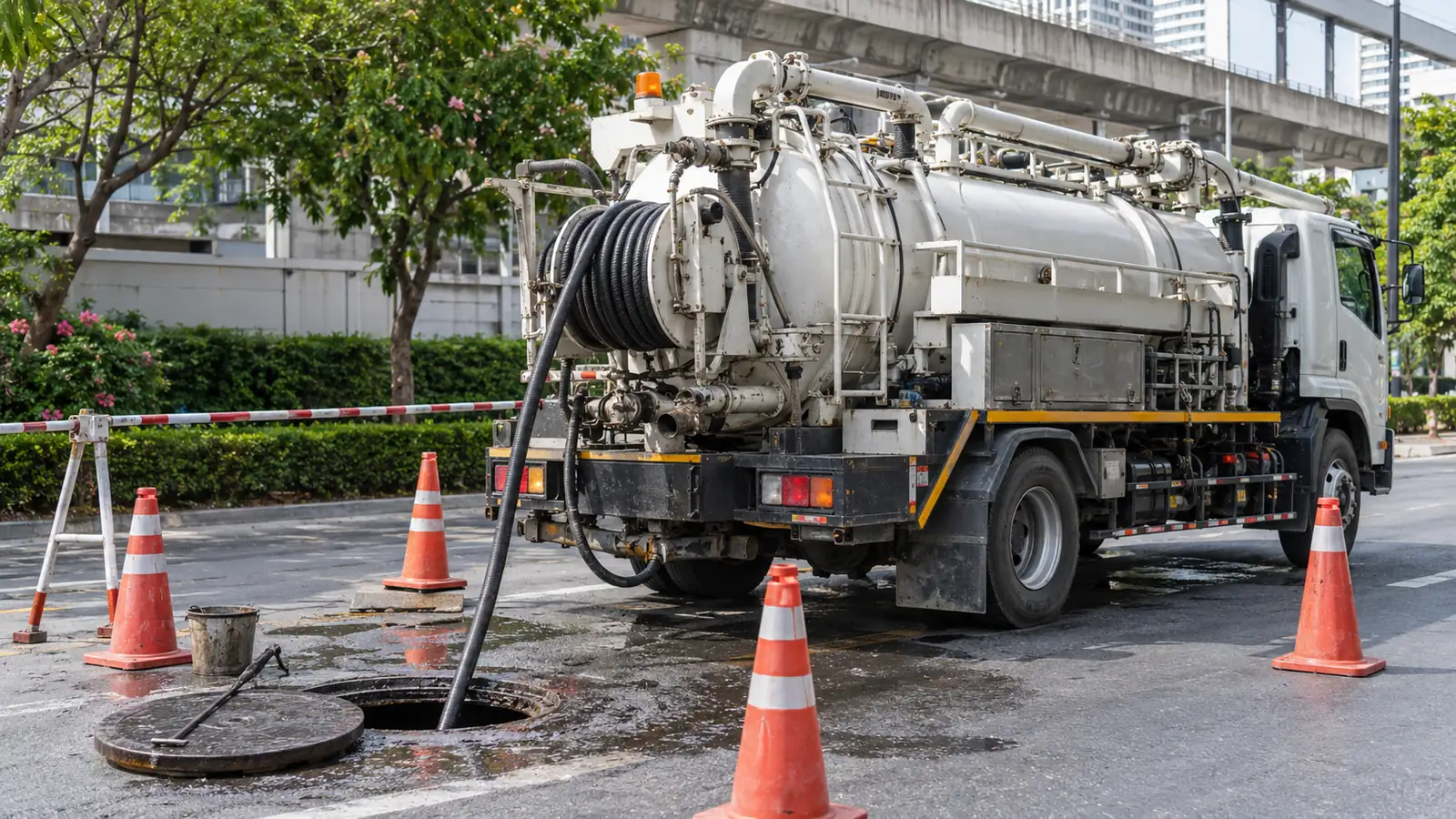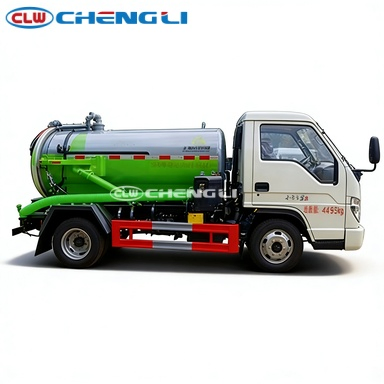
Buying a municipal vacuum truck is a long-term decision. Two costly specification errors are choosing a tank larger than the chassis can legally carry and choosing a pump that cannot work at the actual pit depth. This guide is for vehicle buyers and specifiers, not customers seeking a septic pumping service.
1. Start with the waste and the site
Waste type. Distinguish relatively clear septic effluent from dense sludge containing sand and solids, and from fibrous or corrosive farm waste. These duties may need different pumps, tank materials and hoses. Describe the liquid accurately before choosing a vehicle.
Access. Measure the narrowest street, turning space, bridge weight limits and gradients on the operating route. A compact 4×2 may serve more collection points than a larger 6×4 that cannot reach them. Compare actual model dimensions with the route.
2. Calculate capacity by weight, not just volume
Available payload = permitted gross vehicle weight − actual unladen weight. Then calculate weight-limited volume = available payload ÷ measured liquid density. Density varies with solids content. An 8 m³ tank carrying sludge denser than water may reach the legal weight limit before it is full.
Use the lower of the tank's working volume and its weight-limited volume to plan trips. Confirm the vehicle's actual unladen weight, axle loads, tank construction and optional equipment in the final technical agreement.
3. Size the tank for the operating cycle
Estimate each full cycle: travel to the collection point, position the truck and hose, fill the tank, travel to an authorised treatment facility, and discharge. A larger tank can reduce trips where disposal is far away. Where disposal is nearby but access is restricted, smaller vehicles may complete more work. Calculate both options using actual route and service times before finalising a tender specification.
4. Specify the pump, hose reach and pit depth
Vacuum lift has a physical limit. Atmospheric pressure gives a theoretical water lift of about 10 m; practical lift is lower after hose friction, fittings, liquid density and site conditions are considered. Do not treat a nominal pump rating as a guaranteed working depth.
Provide the vertical distance to the liquid level, the horizontal distance from the parking position to the pit, and the required hose diameter. A 4-inch (about 100 mm) hose is common for many septic applications, while heavy sludge may call for a larger line. Base hose length on the longest measured site.
Rotary-vane vacuum pumps can suit general septic work if properly protected by traps and overflow controls. Blowers may suit duties requiring higher airflow or longer hose runs. Liquid-ring pumps can tolerate wet conditions but require seal-water management. Confirm pump suitability, flow and acceptance-test conditions for the specific waste and configuration.
5. Match discharge to the receiving facility
Choose the discharge equipment after checking what the treatment facility accepts. Gravity discharge is simple when the receiving point is lower than the outlet. Pressure discharge may move liquid uphill or through a longer line, but requires suitable pressure safeguards, gauges and tank documentation. A tipping tank can help with thick sludge, at the cost of extra unladen weight and hydraulic maintenance.
Discuss mixed clear-liquid and sludge duties with the facility operator before specifying more than one discharge method.
6. Plan for odour control, cleaning and tank materials
Specify overflow protection and a trap to reduce the risk of liquid reaching the vacuum pump. A level indicator helps the operator stop filling in time. Access for internal cleaning matters because retained sludge can build up and reduce working volume.
Coated carbon steel may suit ordinary septic duty. More corrosive farm or industrial liquids may require stainless steel or a specialised lining. State material grade, wall thickness and cleaning access in measurable terms. Evaluate odour controls where routes pass homes or markets.
7. Compare three municipal configurations
| Criterion | Basic vacuum truck | Vacuum and jetting truck | Heavy-sludge truck |
|---|---|---|---|
| Typical work | Septic pits and community collection | Blocked drains, manholes and mixed duties | Dense sludge, sand and treatment facilities |
| Indicative capacity | 5–8 m³ | 6–12 m³, with separate clean-water tank | 11–15 m³ or more |
| Common chassis | Short-wheelbase 4×2 | 4×2 to 6×4 | 6×4 |
| Narrow-street access | Generally best | Depends on chassis and body | More restricted |
| Main caution | May not suit very dense sludge | Clean water uses part of the payload | Higher unladen weight limits payload |
These ranges are an initial screening guide, not specifications for a particular model. Confirm dimensions, weights and duties against the vehicle offered.
8. Consider whole-life cost
Purchase price is only one part of the budget. Allow for pump wear parts, hoses, couplings, rear-door seals, pump oil, tank corrosion protection, chassis servicing and downtime while waiting for parts. Request a recommended consumables list and unit prices for the first two years. The contract should identify parts availability, claim procedures and separate chassis and body responsibilities.
9. Three questions that shape the specification
What liquid is collected most often? Its density and solids content influence payload, tank volume and pump choice. What is the hardest point to access? Street width, turning space, pit depth and hose run influence chassis and pump selection. Where and how is waste discharged? The receiving facility and travel distance influence discharge equipment and achievable daily trips.
10. Check Thai requirements alongside the vehicle
Public-health permissions. Collection, transport and disposal of human waste may fall under Thailand's Public Health Act B.E. 2535 and related regulations. Ask the local authority about permits, sealed and leak-resistant containment, and required vehicle markings before finalising the tender or beginning operations.
Registration. Ask the provincial Department of Land Transport office where the vehicle will be registered to confirm its category, gross and axle weights, body requirements and documents before production.
Emissions. Thai requirements for larger diesel vehicles include TIS 3046-2563, effective 1 January 2024. Confirm which current standard applies to the exact vehicle and which documents the authorities accept. A foreign engine-emissions designation alone does not establish Thai approval.
Right-hand drive. Specify right-hand drive in the quotation and technical agreement for Thailand. Inspect the actual vehicle before shipment; do not infer steering position from a photo or model name.
Documents and procurement. List model-specific certificates and registration documents in the contract. Public tenders should use measurable performance criteria and a clear acceptance method. Seek local regulatory and procurement advice where needed.
11. Put purchasing terms in writing
Request a quotation identifying the chassis and pump models, verified working capacity, included equipment, trade term, destination port, production and shipping schedule, payment terms, inspection method, and import and registration responsibilities.
Lead time, warranty and parts availability depend on the model and contract. Do not rely on a generic figure. Agree the scope and cost of any pre-shipment inspection in advance.
12. Twelve checks before ordering
- Measure the usual waste density, solids content and daily volume.
- Confirm permitted gross and axle weights and documented unladen weight.
- Calculate usable volume by weight, not nominal tank size alone.
- Measure narrow streets, turning space, bridge limits and gradients.
- Measure maximum pit depth and hose reach.
- Confirm pump type, documented flow and acceptance-test conditions.
- Specify overflow protection, a trap and a level indicator.
- Check the receiving facility's discharge method and pressure safeguards.
- Specify tank material, wall thickness and cleaning access.
- Specify right-hand drive and inspect the actual vehicle.
- Confirm current Thai emissions rules and required documents.
- Confirm local public-health permits and registration requirements.
Frequently asked questions
Is the largest tank always the best value?
No. Legal payload may limit fill volume first, and a larger truck may not reach narrow collection points.
Can a nominal tank be filled to 100%?
Not necessarily. The vacuum system needs headspace and overflow protection, while the weight limit may be reached first. Plan with verified working volume.
Who is responsible when equipment fails?
Separate chassis, engine, tank, pump and hydraulic responsibilities in the contract. Specify warranty periods, exclusions, parts, labour, transport costs and the claims process.
Can the truck be supplied in right-hand drive?
Require a confirmed right-hand-drive chassis for a Thai project and check it at inspection. Specify the exact model and right-hand-drive chassis in the signed technical schedule.
Which emissions standard applies?
Check the requirements in force for the vehicle class at import and registration, and obtain model-specific documents. A named foreign emissions level is insufficient by itself.
How long will production and delivery take?
Timing depends on chassis availability, equipment, quantity, shipping and import procedures. Obtain separate production and delivery milestones in the contract.
Explore related vehicles
Compare available configurations in the vacuum truck category. Check each model's actual capacity, dimensions, steering position and equipment.
Information to prepare for a quotation
Describe the waste and operating site, desired working capacity, pit depth and hose reach, daily hours and trips, right-hand-drive requirement, applicable emissions standard, quantity and destination port. Contact [email protected] or use the contact page for a project-specific quotation.
Record the required performance, quoted price, delivery schedule and certification-document list in the final technical agreement and contract.